


Citrus pruning is often treated like an annual appointment: a certain month arrives, the shears come out and the tree is “tidied”. Trees do not work that way. Timing depends on species, climate, harvest, vigour and the actual reason for making a cut.

The most useful rule is simple: do not cut merely because it feels productive. A balanced tree may only need dead wood, suckers and badly placed branches removed. Heavy pruning can trigger a strong flush of new growth and create exactly the tangle you were trying to prevent.
When should citrus be pruned?
In Mediterranean climates, substantial work is generally planned away from severe cold, full bloom and extreme heat. But an early Navel orange, a late Valencia and a repeat-flowering lemon do not share the same calendar. Look at the tree before looking at the date.

If it is still carrying a major crop, flowering heavily or suffering drought stress, an important pruning job can often wait. In a commercial grove, picking access, canopy height and movement between rows also influence decisions.

Start with branches you do not need to debate
Dead, broken or damaged wood, branches rubbing continuously, shoots from the rootstock and excessively vigorous upright water shoots are usually the clearest first candidates. Remove those, then step back.
That last part matters. With your face inside the canopy you only see the next branch; from several metres away you can tell whether you are creating useful space or simply hollowing out the tree.
Air and light do not mean an empty centre
Air movement and light are useful, but a citrus tree stripped bare inside is not automatically well pruned. Leaves and smaller branches also shade woody parts. In hot climates, sudden exposure after drastic pruning can leave bark and main limbs more vulnerable.
Aim for gradual passages of light, removing genuine congestion and crossing growth. The canopy needs to be functional, not geometrically perfect.
Lemon and orange do not react in exactly the same way
Lemon trees can be highly vigorous and repeat-flowering cultivars have a more complex flowering calendar. Orange trees build a different canopy, and harvest timing ranges widely between early and late cultivars. Copying one pruning recipe across every citrus tree is a poor shortcut.
The Sicilian citrus calendar is a useful reminder that “citrus” is a collective word. Behind it are species and cultivars with different rhythms.
Pruning a young citrus tree
In the first years, the goal is to build a balanced structure. Correct a badly directed branch while it is still small rather than waiting until it becomes a large limb. At the same time, removing too much leaf area slows a young tree’s growth.
Choose a limited number of well-spaced main branches and let the tree build volume. A catalogue-perfect shape is not the objective; stability, light and ease of future management are.
Why topping often creates more work
Cutting the canopy back brutally can seem like the quickest way to reduce size. The tree often responds by producing numerous vigorous shoots near the cuts. Before long, you have a dense vertical thicket that requires another intervention.
There are restoration situations where major cuts are necessary, but they deserve case-by-case assessment. For old, diseased or very large trees, an experienced local professional is a sensible investment.
Clean tools and considered cuts
Shears and saws should be sharp. A clean cut is preferable to a torn wound. When moving from a tree with suspected disease to another tree, tool hygiene becomes especially important.
Avoid leaving long stubs without reason and do not cut flush through the branch collar. Large limbs demand more skill; if you are uncertain, stopping is often the correct decision.
Good pruning proves itself at harvest
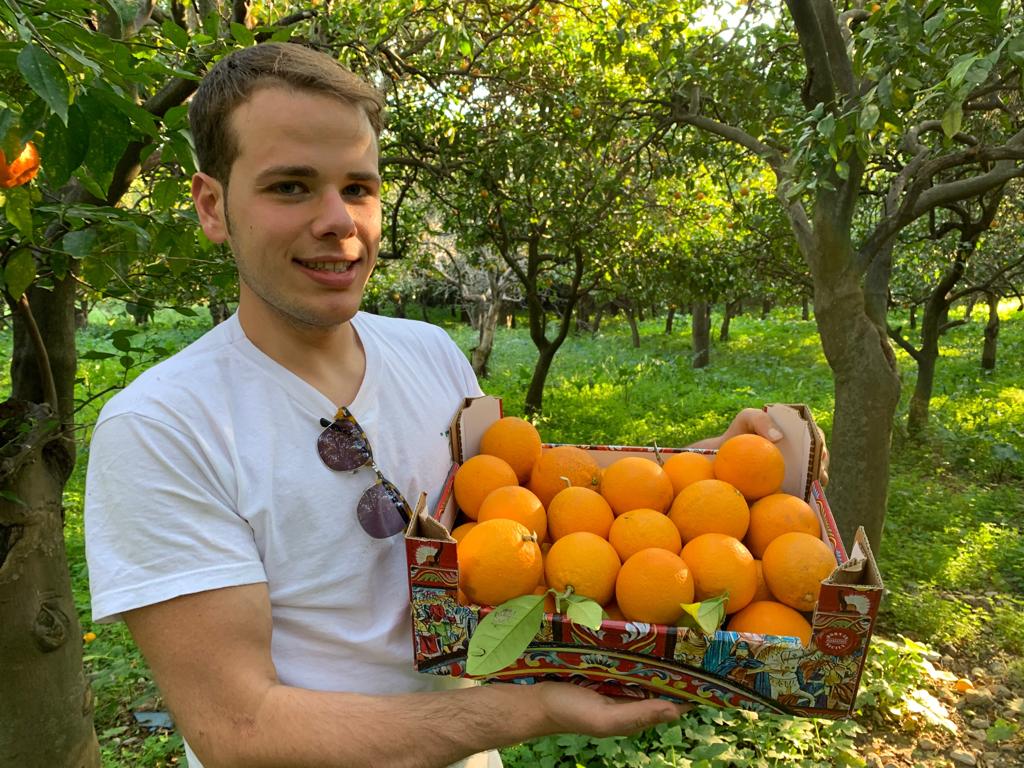
A well-managed canopy allows fruit to be reached, workers to move around the tree and a reasonable balance between vegetation and production. In a Sicilian citrus grove, pruning is not an aesthetic exercise: it is one of the jobs connecting spring blossom to the box harvested months later.
To see how different cultivars move through the year, browse the seasonal shop. A citrus grove makes more sense once you stop expecting it to do the same thing every month.


