


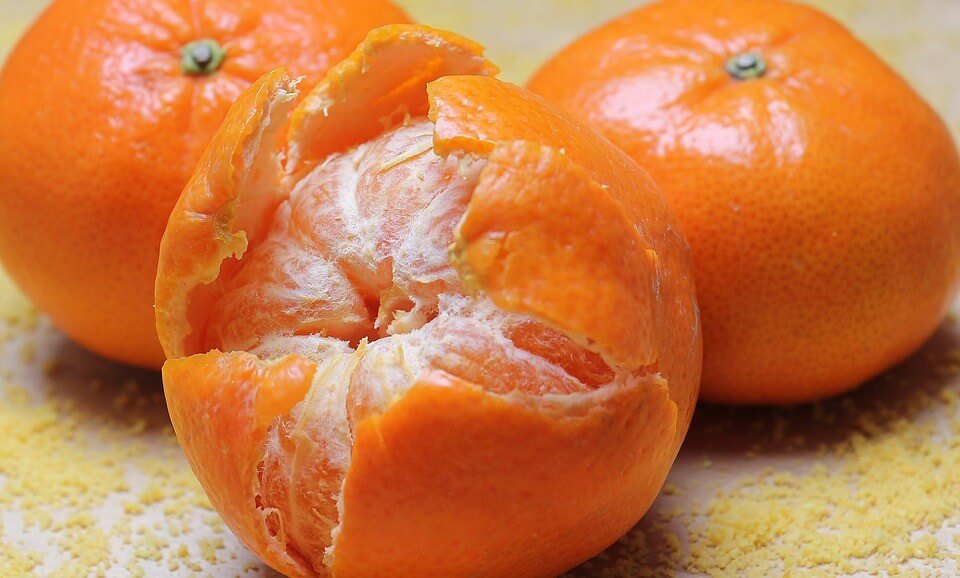
The clementine or Citrus clementina is a citrus fruit belonging to the group of hybrids between mandarins and sweet oranges, which is why it is also commonly known by the name mandarancio. Clementines begin to form around mid-October and then ripen during the winter months. In fact, clementines typically ripen in the fall, while the availability of the fruit continues through February. It flowers and fruits slowly and irregularly, as it is very susceptible to temperature changes, and harvesting occurs once a year. It is a variety of mandarin similar to oranges and mandarins in size and in sweet, juicy flavor that never exceeds in acidity; the fruit, in fact, is obtained by crossing the two, more precisely from the mandarin tree crossed with the bitter orange. The clementine tree is very similar to that of the mandarin, from which it differs in its leaves, which, in the case of the clementine, are larger.
SIMILARITIES WITH ORANGE AND TANGERINE
The main differences can be seen in the color of the flesh, which is definitely more orange, and in the shape, which is not flattened like mandarins but round. Like the tangerine, it peels and splits into wedges with ease; the taste is more like the orange, with a perfect balance between sour and sweet. Unlike the tangerine, clementine segments are almost completely seedless. Very fragrant and sweetish, clementines are eaten fresh or used to make syrups, juices, jams, and in many pastry recipes for making cakes and tarts, or to make ice cream sorbets and jellies.
ORGANOLEPTIC PROPERTIES
On the level of organoleptic properties, clementines are rich in vitamin C, useful in strengthening the immune system against seasonal ailments, as an aid in preventing cardiovascular disease, and in the process of detoxifying the body from harmful substances accumulated over time. In addition, they contain vitamin A-and its derivative retinol-which is of fundamental importance for our eyesight because, together with carotenoids, it is part of the components of rhodopsin, the substance on the retina that provides the eye with sensitivity to light. Vitamin A is useful for bone development and strengthening over time, as well as for the growth of teeth, and is notable for its ability to provide an immune response to our bodies. Recent scientific findings have shown that vitamin A also has significant anticancer properties.
CLEMENTINES FIRST SUN

With a ripening period from October to early November, the first sun clementines are born from a cross between the Miyagawa (or Citrus unshiu, a tangerine of Chinese origin) and the mandarin, inheriting the sweet flavor from the latter. Its flesh is orange in color and seedless, and it is eaten fresh, or intended for juice, jam and ice cream production.
CLEMENTINES NOVA

The Nova clementine is a cross between the Orlando tangelo and the common clementine, and has an oblate, flattened shape at the poles, a deep orange color, and a medium to coarse size. Nova clementines possess a pleasant balance of acidity and sugar, which gives the fruit a very distinctive flavor; it is also seedless and fragrant, like mandarins.


